

At Imaging Future, we are driven by a passion for innovation in EEG technology, particularly in advancing mental health assessment and treatment. Our latest project, the NeuralFidelity Initiative, is a testament to this commitment. Supported by the Danish Life Science Cluster, this initiative is a collaborative effort to push the boundaries of EEG signal precision analysis, making significant strides in both hardware and software development.
The inspiration behind NeuralFidelity:
The concept for NeuralFidelity was inspired by our ambition to create a portable, wireless, high-resolution EEG system that is both advanced and accessible to clinicians.
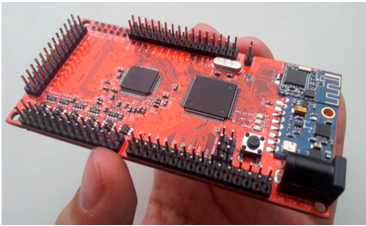
Drawing on insights from the article “Development of a Modular Board for EEG Signal Acquisition” (see small PCB to the right, 16 channels), we were motivated to design our own system. Initially, with support from the EU regional funds, we began developing a 32-channel system tailored for clinical use, with the flexibility to scale up to 64 channels for more advanced research applications. This dual approach ensures that our technology serves both everyday clinical needs and the rigorous demands of academic research.
Our vision:
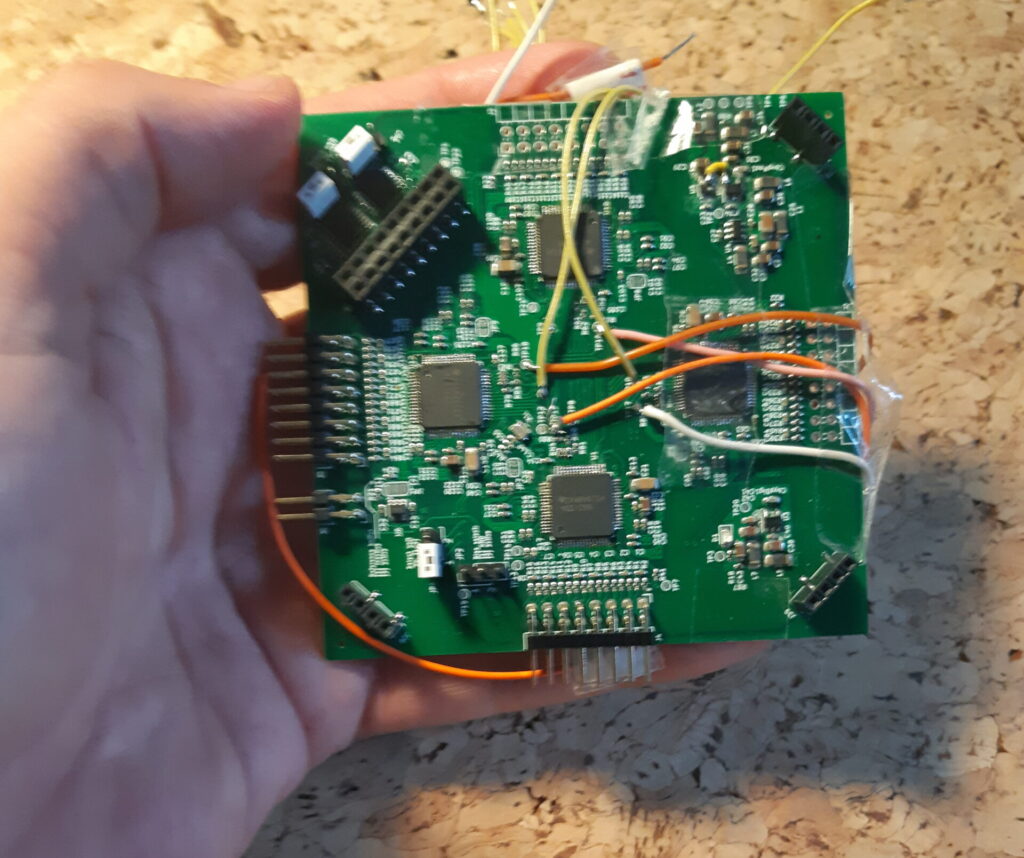
Our goal is to develop a 32/64 channel portable, wireless EEG system that not only meets the high standards of accuracy and reliability required for mental health assessment but also brings a new level of personalization and affordability. The 32-channel configuration is specifically designed to be accessible for everyday clinical practices, offering a robust tool that clinicians can rely on for assessing the functionality and regulation of neural systems. For universities and research institutions, the system can be expanded to 64 channels, providing the enhanced capabilities needed for in-depth fundamental research. To the left is an early prototype of the 32 channel EEG board (2 of these can be stacked for a 64 channel solution).
Project progress:
Since receiving the grant from the Danish Life Science Cluster, we have made substantial strides in validating our portable, wireless EEG system. Our collaboration with DTU, Imaging Future Aps, and Indesman has been crucial in optimizing our hardware design, particularly by integrating and testing a highly advanced analog front-end component. This chosen component is known for its exceptional ability to capture extremely fine electrical signals from the brain, thanks to its high resolution and minimal noise interference. These qualities are vital for ensuring that the system accurately reflects neural activity, which is crucial for effective mental health assessments in both clinical and research settings.
A significant breakthrough in our development process has been the successful wireless streaming of raw data from the 32-channel system. Currently, data is transmitted via TCP to a Python-based server with a minimal delay of just 4 milliseconds between each data packet. While this achievement is a major milestone, we are continuously working on increasing the sampling speed to 500 samples per second (SPS). We’ve encountered challenges, particularly with the system’s memory capacity, which may limit higher-speed buffering, but we’re exploring more powerful alternatives to overcome this.
In parallel, we are also developing a custom EEG cap that uses saline electrodes, tailored to fit each individual’s head perfectly. This customization is crucial for ensuring both comfort and the accuracy of electrode placement, which in turn enhances the quality of the data collected. This EEG cap is designed to work seamlessly with our wireless system, providing a comprehensive solution that is both user-friendly and highly effective for clinical assessments and research.
Looking ahead:
As we continue to refine the NeuralFidelity system, our focus remains on ensuring that it is both cost-effective for clinical use and scalable for advanced research applications. By addressing the technical challenges and optimizing our system, we aim to make high-quality, portable, and wireless EEG assessments more accessible to clinicians and researchers alike.
Join us on this journey:
We invite you to follow our progress on the Imaging Future website, where we will share regular updates and insights from our work on the NeuralFidelity Initiative. Together, we can make a meaningful impact on the future of mental health care through innovation, affordability, and collaboration.
Conclusion:
The NeuralFidelity Initiative is more than just a project; it is a movement towards better, more personalized, and accessible mental health care. With the support of the Danish Life Science Cluster, we are excited to explore new frontiers in EEG technology and to share our findings with the world.